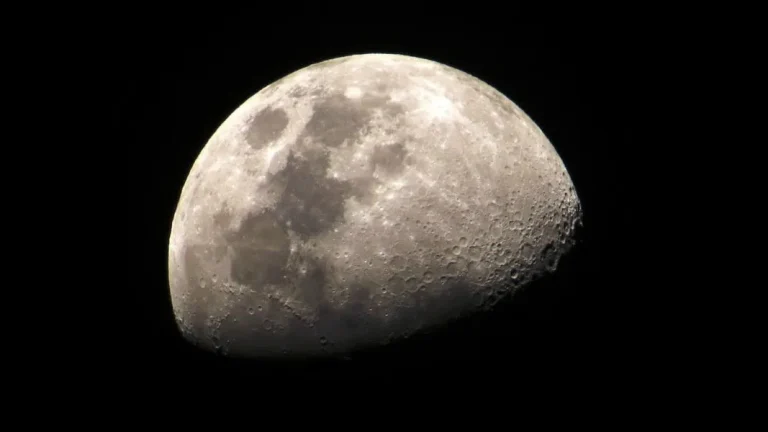
What Australia and NASA are planning for a return trip to the Moon is like a camping excursion compared to the Apollo project.
Gerald Sanders from NASA Johnson Space Centre tells AAP that “we use the term living of the land.”
NASA wants to know how to best use resources in the places where missions are landed rather than blasting off everything and bringing it back.
Neil Armstrong and Buzz Aldrin walked on the Moon for the first time in 1969. The last Apollo mission, which took place in 1972, saw the crew staying more than three full days.
Mr. Sanders said, “We would like to stay there longer.”
He says you will start by bringing smaller habitats to live in while building your more extensive infrastructure for the future.
He is the head of “in situ resource utilisation,” a department focusing on utilizing resources from other planets or moons without leaving a mess.
We will extract metals, ceramics, and silicon for spare parts and, perhaps, the roads and landing pads to protect the hardware.
Sanders says that the film The Martian, in which Matt Damon is shown growing potatoes on Mars, is an excellent example.
NASA’s Perseverance Mars rover has a similar oxygenator to the one he had in that film.
Percy, a car-sized rover, is also supported by a tiny helicopter named Ingenuity. They are searching for signs of past microbial life and rock samples and preparing for future human exploration.
To prepare for the long haul, it is also necessary to rethink what a lunar mission can be capable of. For every kilogram of material that lands on the surface of the Moon, 200kg must be placed on the launchpad.
Mr Sanders says, “If I do not have to bring anything then either my vehicle gets smaller, or I can fill my vehicle with things more important than a tank or oxygen or even a block metal that I’ll turn into something.”
We’re going to start small. We’ll run some basic tests and see if our ideas work. Regolith is a fancy name for the soil of the Moon.”
The technology is being developed to convert regolith, not carbon dioxide, into metals.
Dr. Jonathon Raston is Mr. Sanders’ counterpart in CSIRO. He is the Australian leader of a team developing technologies NASA will require.
Dr. Ralston told AAP that there was no carbon or water, and it was challenging to generate energy on the Moon.
“The first thing we need to do is understand the resource to understand how to use it best.
“It will need to be green from the start,” says Dr Ralston.
He said, “It is about using the materials you have and doing it in a closed loop.”
Some processes use water or acid to extract or leach certain metals out of lunar regolith, but these must be developed and cannot be vented to the Moon.
Repurpose and recycle everything instead.
Sanders states that “circular economy is baked in to everything we do”.
It’s a high-stakes game, as producing just one kilogram of water, oxygen, or material for construction on the Moon can save thousands of dollars.
Researchers are facing a unique situation. Typically, satellites, rovers, or other space equipment must be developed in a clean environment.
The University of Adelaide, for example, is testing in “dirty” vacuum chambers.
Dr. Ralston says, “They simulate the hard vacuum that you find on the Moon.”
It’s hard to imagine what an airless vacuum would be like or what it could do to all your electronic systems and electronics.
He said regolith was a great resource that could generate critical life support. Still, it also presented a challenge due to its abrasive nature and tendency to stick to mechanical parts.
“The material can be both a friend or a foe,” says Dr Ralston.
He said, “We are moving away from a mission that is short-term to how we would begin to establish sustained activity.”
All equipment must be robust and low-maintenance.
Remotely controlled robots could be used to monitor the site using technology developed for mining.