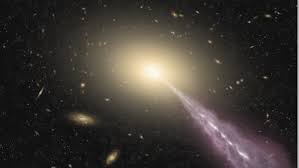
New research reveals that the supermassive black holes at the center of galaxies, known as quasars, can sometimes be obscured by dense dust and gas clouds in their host galaxy.
The idea that black holes are obscured only by dust rings in the form of donuts is challenged.
Quasars, which are bright and extremely powerful objects, are powered by black holesblackholes that gobble up surrounding material.
If thick clouds are between us and a quasar, their powerful radiation will be blocked.
Astronomers believed that this material was only present in the immediate vicinity of a quasar, in “dusty donuts” or toruses.
A team of scientists from Durham University has found that the obscuration in some quasars is caused entirely by the galaxy where the quasar is located.
Using the Atacama Large Millimeter Array in Chile, researchers observed a sample of very dusty quasars that had high rates of star formation.
The researchers found that these quasars are located in galaxies with a very small size, called “starburst galaxy,” which is no larger than 3000 light-years across.
The starburst galaxy can produce more than 1,000 stars the size of the Sun each year.
Gas and dust are the basic building blocks of stars.
The quasar can be completely hidden by the clouds of dust and gas that are created when stars form rapidly.
The complete study has been published by the journal MNRAS.
Carolina Andonie is the lead author of the study. She is a PhD student at the Centre for Extragalactic Astronomy, Durham University. “It looks like the quasar has been buried within its host galaxy.”
In some cases, gas and dust are so dense that not even X-rays can escape.
“We thought that the dusty donut surrounding the black hole was all that covered the quasar.
Now we realize that the entire galaxy is welcome to join us.
This phenomenon seems only to occur when the quasar undergoes a rapid growth spurt.
The team estimates in 10-30% (or more) of quasars that are rapidly forming stars, the host galaxy alone is responsible for the quasar’s obscuration.
These findings offer new insight into the relationship between galaxy growth, black hole activity, and other factors.
Quasars that are obscured may be an early stage of evolution when galaxies have a lot of cold gas and dust. This fuels high rates of star formation and the growth and development of black holes.
The study’s co-author, Professor David Alexander of Durham University, said: “It is a turbulent and messy phase of evolution when stars and gas collide in the center of the galaxy.
The baby quasar is cloaked in a cocoon of dust by the cosmic food fight.
Scientists can better understand galaxies by revealing these supermassive blackholes.