The industrial umpire has decided to raise the minimum wage and award wages for nearly 200,000 workers in Australia. This is a historic pay increase of 8.6 percent.
The Fair Work Commission released its findings on Friday regarding the annual wage review. Most changes are expected to take effect during the first pay period after July 1 or the second entire pay period.
Around 2.5 million award-reliant employees, or nearly one-fourth of all Australian employees, will see their wages rise by 5.75 percent. Meanwhile, 184,000 workers earning the minimum wage in Australia will get a record-breaking 8.6 percent increase.
The minimum weekly wage for workers earning the national minimum will increase by approximately $70 per week. It will go from $812.60 to 882.90. Their hourly rate will also rise from $21.38 to $23.23.
Workers reliant on awards will see their hourly rate increase by $1.23, from $21.38 up to $22.61, and their weekly rate rise by $46.72 or $859.32.
The FWC made a historic decision to change the classifications of workers based on the national wage. This ended the 25-year alignment between the C14 award rates and an introductory rate for many awards.
The FWC announced on Friday that workers on the minimum wage would now receive a 5.75 percent increase in their pay, which equates to an 8.6 percent increase.
These workers do not receive any awards, representing just 0.7% of all employees.
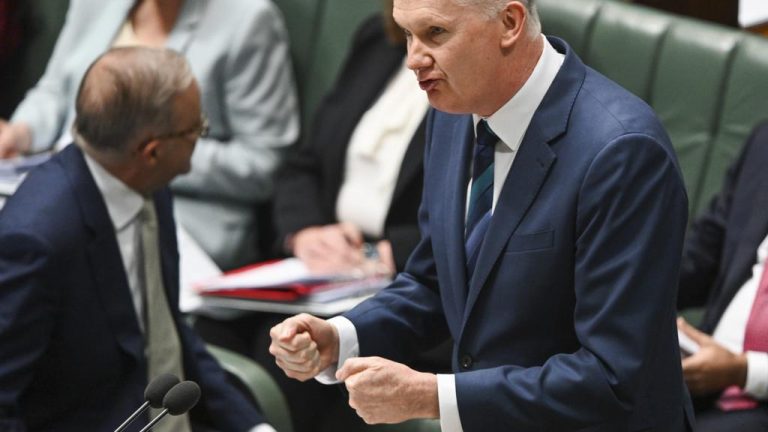
Tony Burke, Employment Minister, praised the increase in the minimum wage as “the most important decision that we’ve ever made” for workers.
He told reporters in Sydney that the government’s actions were the only reason it was possible.
There are more changes we must make. We will be addressing the loopholes that allow wages to be undercut in the second half of this year.
Mr. Burke knew that people earning the minimum wage still had difficulty.
The government is not a pretender.
For the second consecutive year, the Albanese government argued that low-paid workers should receive a pay rise in line with the inflation rate – which was 6.8% in the twelve months ending in April.
Last year, the FWC raised the minimum wage to $21.38 an hour or $812.60 per week. This was at a time of 5.1 percent inflation.
After a review between March and June, the independent tribunal sets the national minimum wage each year.
The FWC did not raise the national award rate of pay to keep pace with inflation this year. This means that workers paid by the award cannot keep up with consumer price increases, at least for the short term. Inflation isn’t expected to reach a more manageable 3.25 percent until 2024.
The 5.75 percent increase was above the midpoint of 5.25 percent between the 7 percent increase requested by the Australian Council of Trade Unions and the 3.5% increase employers ordered.
The peak union in Australia has urged the FWC to increase the minimum wage hourly for the lowest-paid people in Australia to $22.88 per hour from July. This would bring the annual salary for these workers up to $45,337.
The FWC decision has caused a rift between unions and employer groups. Business leaders have warned that significantly higher wages may lead to a “wage spiral” whereby extra spending will drive inflation.
Justice Adam Hatcher, FWC’s president, said that the result of the annual salary review would have a limited economic impact.
Justice Hatcher stated, “We emphasize that the annual wage revision process is not an adjudication process between competing proposals.”
“While considering the comments, our ultimate statutory duty is to determine what constitutes a security net.”
Justice Hatcher stated that the current economic conditions — low unemployment, declining wages, and high inflation — were “very uncommon” and made the FWC decision challenging.
He said that a sharp economic growth slowdown is expected over the coming year.
The business community’s reaction to this FWC decision was swift and dismayed.
Andrew McKellar, the Australian Chamber of Commerce and Industry chief executive in Canberra, told reporters he was disappointed in the FWC’s decision.
He was also surprised that the FWC said the wage increase would not generate a spiraling price.
He said: “If you combine this with the other pressures already placed on businesses, we can’t see how it is possible.”
This adds to the pressure on businesses in terms of prices and margins.
Labor’s submission for the FWC 2023 wage review was published in March. It did not include how much wages should increase but stated that “low-paid employees” shouldn’t “go backward.”
The FWC wage review for 2023 was the first to include gender equality as an objective.
The FWC should not consider inflation as the sole factor when determining wages.