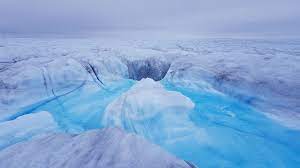
In the recent past (416 000 years ago), Greenland had a large area of ice-free tundra, perhaps covered with trees and woolly mammoths roaming around. A new study published in Science shows this.
* The findings help overturn the previous belief that the Greenland Ice Sheet remained largely intact for the past two and a quarter million years. Moderate warming caused the melting from 424,000 to 374 000 years ago.
* The melting of Greenland at that time caused a sea level rise of at least five feet, despite the atmospheric levels of carbon dioxide trapping heat being much lower than they are today (280 vs.420 ppm). This suggests that the Greenland ice sheet may be more susceptible to climate change caused by humans than was previously thought. It will also be vulnerable to irreversible rapid melting over the next few centuries.
Scientists from the University of Vermont, Utah State University, and 14 other institutions used sediments collected in the 1960s at a secret U.S. Army Base to make this discovery. The scientists used advanced luminescence techniques and isotopes to determine the duration and timing of the ice-free period.
Green Land
During the Cold War, a secret U.S. Army operation at Camp Century in northwestern Greenland drilled through 4560 feet (or 12 meters) of ice to reach the soil and rock beneath the ice. This ice sediment was then lost in a refrigerator for many decades. In 2017, it was discovered accidentally and contained not only residue but also leaves, moss, and remnants of an ice-free landscape, possibly a boreal woodland.
How long ago did those plants grow when today there is an ice sheet three times as large and two miles thick?
A team of international scientists was surprised to learn that Greenland used to be a lush green landscape only 416,000 (with a margin of error of approximately 38,000) years ago.
The new study was published in Science on 21 July 2023.
Bulletproof Evidence
Geologists used to believe Greenland had been a solid fortress of ice for millions of years. Two years ago, a team of scientists using the newly discovered Camp Century ice core showed that this likely happened less than a million years ago. Scientists in central Greenland gathered data showing the ice melted there at least once during the past 1.1 million years. But until this study, nobody knew when precisely the ice was gone.
Based on advanced luminescence and rare isotope analyses, the team’s new findings paint a much starker picture. Large portions of Greenland’s ice sheet have melted far more recently than one million years ago. The new study provides direct evidence that the sediment beneath Greenland’s ice sheet was formed by flowing water during a period of moderate warming called Marine Isotope Stage 11 between 424,000 and 374,000 years ago. The melting of the ice sheet caused a sea level rise of at least five feet worldwide.
It’s the first proof that the Greenland Ice Sheet vanished as the climate warmed up, says University of Vermont Scientist Paul Bierman. He co-led this new study with Drew Christ, the lead author, a geoscientist post-doctoral who worked in Bierman’s lab, Professor Tammy Rittenour of Utah State University, and 18 other scientists worldwide.
Understanding Greenland’s past will help you predict how the giant ice sheet in Greenland will react to future climate change and how fast it will melt. Greenland’s sea level rise is about 23 feet, which puts every coastal area at risk. Greenland’s vulnerability to climate change is more significant than previously thought, and it faces a grave risk of melting irreversibly.
Bierman says the Greenland past preserved in 12 feet of frozen ground suggests a future for Earth that is warm, moist, and mostly ice-free. He’s a geoscientist at UVM’s Rubenstein School of the Environment and Natural Resources and a fellow at the Gund Institute for Environment.
The Light
Combining their new Science study with earlier research, the team is forcing a major and worrying rethinking about the history of the Greenland ice sheet. Tammy Rittenour is a co-author of the new study and a scientist from Utah State University. “We always assumed the Greenland Ice Sheet formed around two and a quarter million years ago and has been there ever since. It’s stable,” she says. “Maybe it melted at the edges, or it became fatter with more snowfall–but that doesn’t mean it’s gone. This paper proves that it happened.”
In Rittenour’s lab, sediment from Camp Century was examined to determine if it contained a luminescence signal. The sun can erase any luminescence signals from bits of rock or sand carried by the wind or water. Over time, quartz and feldspar minerals in sediments accumulate electrons freed in darkness. Rittenour’s team exposed pieces of ice core sediment to infrared or blue-green light. This released the trapped electrons. The number of electrons released can be a clock that tells you when these sediments last were exposed to sunlight. Rittenour says that Camp Century can only do this by removing a mile of snow. “Plus, to grow plants, there must be light.”
These new insights were combined with the wisdom gained from Bierman’s UVM lab. Scientists study the quartz core from Camp Century. When the Earth is exposed to cosmic rays and the sky, the rare aluminum and beryllium isotopes build up inside this quartz. Scientists could determine how long the rocks on the surface had been exposed by comparing the ratios of isotopes and beryllium. The data showed that the Camp Century sediment had been exposed to the skies for less than 14,000 before being buried under layers of ice. This helped scientists narrow down the period when Greenland was free from ice.
Under Ice
In the 1960s, Camp Century was a secret military base in tunnels beneath the Greenland Ice Sheet. The camp had a strategic goal, Project Iceworm. It was to conceal hundreds of nuclear weapons under the ice near the Soviet Union. The Army used the cover of an Arctic science station to hide the camp.
The missile mission failed, but the team completed groundbreaking research, which included drilling an ice core nearly a mile deep. Scientists at Camp Century focused their attention on the ice to better understand Earth’s previous ice ages and warmer periods (the interglacials). The scientists were interested in something other than the 12 feet of sediment collected from underneath their ice core. In a strange story, an ice core from a military refrigerator was transferred in the 1970s to the University at Buffalo and then in the 1990s to a Danish freezer. It was there for decades until it was discovered again as the cores of a new refrigerator were being moved. You can read more about the core’s loss, its re-discovery in cookie jars, and the study by an international team at the University of Vermont Gund Institute for Environment: Secrets Under the Ice.