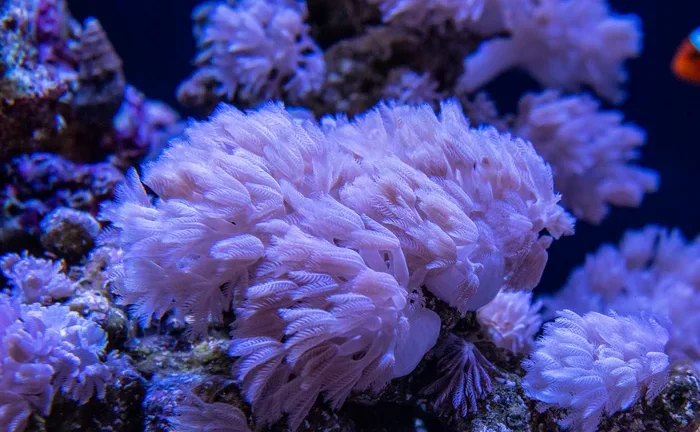
A new study by Carnegie’s Yixian Zhen and Minjie Hu found that coral cells mark friendly algae before consuming them. This creates a mutually-beneficial connection. These data could guide future coral conservation efforts.
The findings of the study were published in the journal Nature Microbiology.
Corals are marine animals that produce exoskeletons used for reef building. The coral’s architecture is possible only because of a mutually-beneficial interaction with dinoflagellates – a group of single-celled alga species that live inside coral cells.
The algae that live on corals use photosynthesis to convert the Sun’s energy. They also share the nutrients created by the algae with the coral hosts.
Coral reefs have great value in terms of aesthetics, ecology, and economics. Many communities rely on them for food and tourism. Human activity, however, is putting pressure on these communities. This symbiotic partnership is affected by pollution, acidification, and warming oceans.
Scientists at Carnegie, including Zheng, Hu, and others, have studied the molecular and cellular mechanisms underlying coral-algae coexistence for many years. Understanding these mechanisms could help develop efforts to prevent bleaching and promote coral resilience.
Researchers Yun Bai, Xiaobin Zhang, and Carnegie’s Yun Bai used bioinformatics and molecular technologies to uncover the early stages of symbiosis when coral takes up algae.
The coral secretes a molecule called LePin. It is concentrated at the mouths of corals where it can attach to algae entering and label them so they are taken into coral cells.