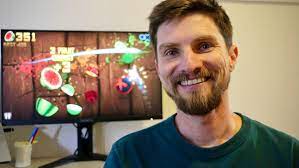
Luke Muscat didn’t imagine his idea of an iPhone game based on late-night knife ads would be a worldwide phenomenon.
The idea was simple: slice fruit in mid-air using a sharp knife.
Fruit Ninja became one of the most recognizable games of its time, mindless for bus stops, commercial breaks, and, unfortunately, for a particular age group in classrooms.
Fruit Ninja, a game that is highly addictive for those who are not familiar with it, involves a variety of tropical fruits being thrown from the bottom screen. The player’s thumb acts as a blade, cutting and obliterating the fruit. Juices are splattered all over wooden walls.
In 2009, the global financial crisis was at its height. The Australian dollar rose, but it was negative for the gaming industry.
Luke Muscat, a designer aged 25, worked at Halfbrick Studios.
He said that the exchange rate had changed dramatically, and we were no longer a desirable area to hire workers.
Halfbrick, based in a small office on Brisbane’s Inner-Northside, had focused on creating games for large studios abroad.
Luke and his team thought they had about a year to make things right.
Every second Friday, they pitched ideas in hopes of finding a winner.
Luke had just experienced a personal setback, as a complex game he designed called Rocket Racing needed to perform better.
“It was an absolute disaster.” He said that it was not a game of profit.
A late-night advertisement for knives that cut through anything came to my mind.
“They throw a fruit in the air and then cut it while it’s still flying.” Luke replied, “I thought this would be a fun game.
Luke’s colleagues could have been more enthusiastic about the idea.
It seemed too easy, especially for a studio that had made challenging, complex games in the past. It looked like a child’s toy.”
The stars must align for a simple idea to be successful.
Luke Gatling and Joe Gatling, a fellow designer, worked on an iPhone game while the rest of the team helped create a new game for another studio.
We sat together and brainstormed ideas. We had about 30 views.
Fruit Ninja was the best of all. It was the best game to play.”
“Oh, this is real.”
The game was completed in just six weeks. The game was released in April 2010, along with an advertising campaign featuring a park near the Brisbane River and a budget advertisement highlighting the ninjas’ age-old dislike of five-day diets.
Luke said that it was not an instant success.
He said, “I’m sure I made at least $100 the first day.”
It was, however, destined to be great. Downloads began to increase after the Apple App Store featured the game.
By July, the game had been downloaded over 1 million times.
Fruit Ninja saved the life of a struggling gaming studio.
It was both exciting and a relief. It’s surreal to see the numbers come in.
He remembers his first encounter with someone playing Fruit Ninja on a public platform.
He said, “It was in a pub, and I heard a distinctive sound that you hear when you first start the game. I thought I had heard it from playing the same game at work. I’d heard this sound about 10,000 times.”
“I remember watching someone play, and it was the first time I had ever seen someone organically play something I had made. This was much more powerful than looking at the numbers on a spreadsheet.
1 billion downloads later
In 2015, the game was downloaded over 1 billion times. Luke and his Fruit Ninja team had passed the duties on to another group.
Luke didn’t make “Fruit Ninja Money,” He was fired from Halfbrick with no remembrance. But he is happy that the game, which started as an idea thrown away, became the driving force behind jobs in a time when the industry “collapsed.”
He explained that Halfbrick Studios had grown significantly since Fruit Ninja was released.
In 2009, 70 percent of the game jobs in Australia disappeared… large sections were being eliminated. Fruit Ninja was one of only a few places in Australia that offered open job listings.