The James Webb Space Telescope, the most powerful astronomical observatory launched into space, celebrated its first anniversary on Wednesday. The telescope is operated jointly by NASA, Canadian Space Agency, and European Space Agency. Over the last year, It has given countless insights into the natural world.
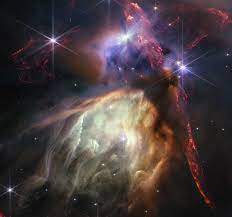
JWST’s first anniversary was marked by the release of data on the star-forming area Rho Ophiuchi. The cloud complex is one of the closest to Earth. It’s only 390 light-years away, according to the latest estimates. The image shows 50 stars younger than 1 million years (compared to the Sun’s age, which is 4.6 billion). They all have a mass about equal to the Sun.
The T Tauri star is a term used to describe many of the objects that were photographed. They are not known for their nuclear fusion but rather for the radiation produced by the shrinking star. They will shrink enough in 100 million years to reach a temperature allowing atomic fusion from hydrogen to Helium.
The dark areas consist of dense clouds of dust that are so thick not even JWST’s specialized instruments can capture the light they emit. The large, red streams are molecular hydrogen, and they can be called Dark River clouds or Rho Ophiuchi Streamers. They form when a new star emits enough radiation to fling its natal dust cocoon and shoot out jets into deep space.
The image shows some stars with signs of protoplanetary disks – potential future planet systems still forming.
JWST data confirmed that the protoplanetary disk surrounding star d203-506 in the Orion Nebula was a methyl cation. The first prediction of CH3+ in interstellar chemistry was made in the 1970s. However, the first detection was with the MIRI and NIRCam telescope instruments. The first results were announced at the end of June.
Carbon compounds are studied closely because they are the foundation for all life. CH3+, however, is of particular importance because it doesn’t react with hydrogen – which makes up the majority of the visible universe – but it does with many other molecules. This suggests it could act as a catalyst to create other molecules and complex structures such as amino acids, proteins, and, eventually, organic life.
The analysis of the CH3+ also gives insight into the contradictory character of ultraviolet light during the formation of planet systems. These wavelengths are very destructive to organic molecules. (This is why excessive sunlight, which includes ultraviolet light, can cause sunburns or, in severe cases, cancerous skin.) However, ultraviolet light has also been known to destroy young planets’ systems, including ours. This research sheds some light on how ultraviolet light is harmful to organic molecules and necessary for forming the building blocks that make up those molecules. Olivier Berne, the study’s lead investigator at the University of Toulouse in France, elaborates: “This clearly shows how ultraviolet radiation can change the chemistry of protoplanetary discs.” It could play a crucial role in the early stages of chemical life’s origins by producing CH3+, something that was perhaps underestimated previously.
JWST continues to study distant clusters of galaxies. The telescope took a deep field in February of Abell 2744, also known as Pandora’s Cluster. This involved a total of 30 hours of observing with the NIRCam. The cluster comprises four galactic clusters colliding 350 million years ago. Since then, they have produced an array of exotic phenomena.
Abell 2744’s colossal gravitation acts like a lens to focus the light from other objects, which are even farther away, which lie behind Abell 2744 about Earth. JWST scanned more than 50,000 infrared sources at once. All these were galaxies and galactic clusters that date back to the dawn of cosmic history. JWST has collected light from at least two sources that have traveled more than 13 billion miles (or, astronomically, a redshift of greater than 10). This provides insight into the formation of galaxies in the early eras.