The journal Science published new research findings about the gamma-ray burst named GRB 21009A from the Large High Altitude Air Shower Observatory. The LHAASO collaboration completed the study entitled “A tera-electronvolt glow from a narrow Jet in an extremely bright GRB221009A“.
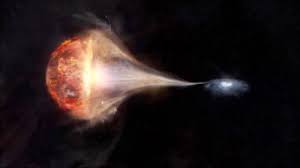
A massive star, more than 20 times heavier than the Sun, used up its fusion energy, collapsed instantly, and ignited a gigantic explosion. This triggered a collimated blast of cosmic fireworks, a GRB (gamma-ray burst), lasting hundreds of seconds. The collision of the fireball with interstellar material generated high-energy photons that traveled across the universe. They headed straight for Earth. These photons arrived at the LHAASO field of view on October 9, 2022. At 13:20:50 UT, they collected over 60,000 gamma-ray photons. Scientists have finally revealed the details of this explosive event after several months of analyses.
LHAASO measures, for the first-ever, the complete light curve of photons with high energy from the GRB afterglow.
The photon flux collected by LHAASO indicates they were from radiation after the main explosion. The primary blast, or prompt emission, is characterized by low-energy gamma-ray radiation. The afterglow results from the matter ejected colliding with interstellar gases at speeds close to light speed. “LHAASO accurately mapped the complete afterglow process for the first time, including the entire phase of tera electronvolt gamma-ray flux, from rise to decay,” stated CAO Zhen. CAO is the principal investigator of LHAASO, spokesperson of the LHAASO Collaboration, and a professor at the Institute of High Energy Physics of the Chinese Academy of Sciences.
Scientists have developed theoretical models that appear to be perfect based on the observations of tens and thousands of GRBs. They have a strong belief in these models. LHAASO has observed the high-energy light curve that other experiments are yet to achieve, providing an excellent database for testing these theoretical models. This event is rare, occurring only about once every millennium. The observed result is expected to be one of the most impressive for several decades, if not centuries.
“At the first onset of afterglow, LHAASO detected the rapid increase in photon flux,” YAO Zhiguo said, a professor from IHEP and one of the corresponding authors. In less than two seconds, the flux increased by a factor of more than 100, followed by a gradual rise that matched the characteristics of an Afterglow. Early rapid enhancement exceeds the expectations of previous models. This raises the question of what mechanisms are at work. The published results will spark in-depth discussion within the scientific community about the mechanisms involved with GRBs. This includes energy injection, particle acceleration, and photon absorption.
LHAASO unveils the mystery of the brightness of the brightest-of-all-time GRB
LHAASO observations show that the brightness of high-energy radiation drops more quickly around 10 minutes following the beginning of the afterglow. This can be explained because the material ejected after the explosion has a jet-like shape, and that the brightness decreases rapidly when the radiation angle reaches the edge of this structure,” said WANG, a Nanjing University professor and one of the corresponding authors. The measured grade of the Jet is 0.8 degrees due to the early brightness transition. This is the smallest jet angle known to date. It indicates that the Jet observed was the brightest core in a typical internally dark and externally bright Jet. The observer is directly facing the most brilliant part of the Jet. This explains why the gamma-ray burst was the brightest ever recorded and why it is so rare.
In the short period of the event, the photons recorded by LHAASO exceeded the total number of photons observed in the Crab Nebula “standard candle” over the last few years. ZHA Min, a professor at IHEP, and one of the corresponding authors said that if the selection criteria were slightly relaxed, the photon count might even reach 100,000! Other instruments have detected less than 1,000 photons from other GRBs and can only detect photons 10 seconds after the event. Please watch for LHAASO’s subsequent analysis results,” said Prof. CAO. He expressed optimism for future achievements by LHAASO.
Background Information: GRB
The GRBs have been the most intense explosions ever since the Big Bang. The sudden increase in gamma-ray emission in one direction of the sky is what they are. GRBs may last for a fraction or a few hours. GRBs can last for a fraction of a second or several hours. They are created by merging two compact celestial bodies, such as neutron stars or black holes.
The Fermi spacecraft detected the first GRB on October 9, 2022, at 13:16.59.59 UT. It was given the international convention name GRB221009A. This burst was observed by dozens of detectors, both on the ground and in space. This GRB has a longer duration, and its brightness is several tens of times brighter than previous GRBs. The high photon flux overwhelmed the detectors in multiple international experiments. China’s LHAASO satellite, the High-Energy Burst Explorer satellite (HEBS), and the Insight-HXMT Satellite detected this GRB simultaneously, allowing for wide-ranging observations spanning eleven orders of magnitudes in energy. Preprints of satellite observations were published on March 28, 2023. Joint data analysis using both space and ground observations was carried out extensively. More research findings are to be published in the future.