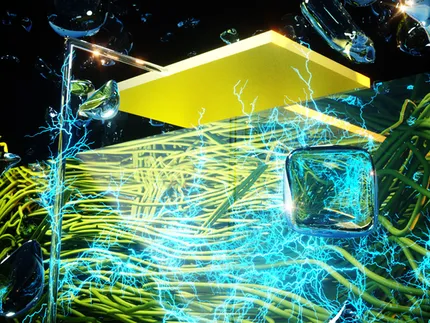
Engineers at the University of Massachusetts Amherst have recently demonstrated that almost any material can be transformed into a device that continuously harvests energy from the humidity in the atmosphere. The secret is to be able to sprinkle the material with nanopores smaller than 100 nanometers.
“This is exciting,” said Xiaomeng Liu. He’s a graduate student studying electrical and computer engineering at UMass Amherst College of Engineering and the paper’s lead author. “We’re opening a new door to harvesting clean energy from thin air.”
The air is filled with electricity, says Jun Yao. He’s an assistant professor of Electrical and Computer Engineering at UMass Amherst and senior author of the paper. Imagine a cloud as a collection of water drops. The cloud comprises a mass of water droplets, each with a charge. When conditions are just right, the cloud will produce a bolt of lightning. But we need to learn how to collect electricity from lightning reliably. We’ve created a small, human-made cloud that can produce electricity continuously and predictably so we can harvest it.
The core of the cloud is what Yao, Lovley, and their colleagues call the “generic Airgen effect.” This builds on the work Yao, Lovley, and Derek Lovley completed in 2020, showing that electricity can be continuously harvested using a material made from protein nanowires derived from Geobacter sulfreducens.
Yao says, “We realized that after the Geobacter was discovered, the ability to produce electricity from the air – what we called the “Air-gen effect” – turns out to be a generic property: any type of material, so long as it has certain properties, can harvest electricity from the atmosphere.”
What is the property? It must have holes smaller than 100 nanometers or less than one-thousandth the width of human hair.
The “mean-free path” is a parameter that describes the distance traveled by a single water molecule in the air before it bumps against another single water molecule. The mean free path of water molecules suspended in air is approximately 100 nm.
Yao and his co-workers realized they could create an electricity harvester around this number. The harvester would consist of a thin material layer filled with nanopores less than 100 nm, allowing water molecules to pass from the upper part of the material down to the lower. The water molecules will bump against the pore’s edge as they pass the thin layer because the pores are so tiny. The upper part of the thin layer would then be bombarded by more water molecules carrying charge than the lower portion, creating an imbalance in order, similar to that found in clouds, as the upper section increased its cost relative to the lower. This would make a battery that will run as long as the air is humid.
“The idea is simple,” says Yao, “but it’s never been discovered before, and it opens all possibilities.” The harvester could be designed from various materials, offering broad choices for cost-effective and environment-adaptable fabrications. You could imagine harvesters made from different materials for different environments.
Since humidity is always present, the harvester will run 24 hours a day, whether it’s raining or shining, night or day, and regardless of whether the wind blows. This solves a significant problem of technologies such as wind or solar, which only function under specific conditions.
Finally, since air humidity diffuses over three dimensions and the thickness is just a fraction of a hair’s width, thousands of Air-gen devices can be stacked together, increasing energy output without increasing the device’s size. This Air-gen device could deliver kilowatts of power to the electrical grid.
Yao says, “Imagine an electric future where clean energy is readily available everywhere.” The generic Air-gen effects mean that this futuristic world can become a reality.