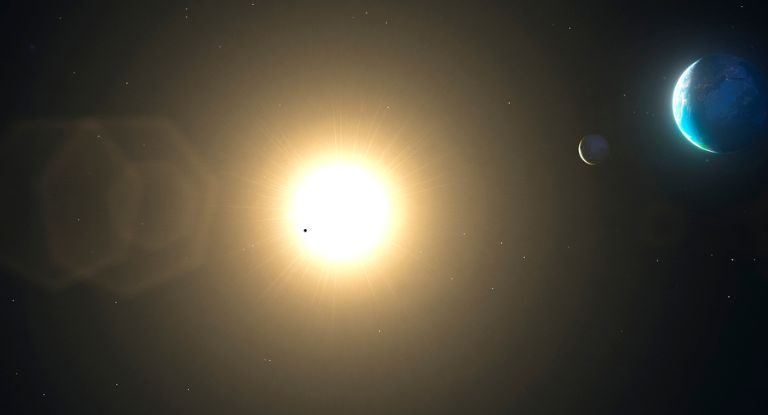
Scientists may have underestimated the size of the Sun, the star at the center of our Solar System.
Two astronomers have found that the Sun’s radius is actually a few hundredths less than what previous analysis indicated.
It might not seem like much, but it can make a significant difference to how scientists view the glowing ball that keeps our planet alive.
These new results are currently being reviewed by peers and are based on the sound waves trapped in the Sun’s hot Plasma, also known as ‘pressure modes.’ These resonating sounds can indicate that pressure changes are occurring inside the solar gut.
According to Masao Takata, an astrophysicist from the University of Tokyo, and Douglas Gough of Cambridge University’s Department of Physics, the p-mode allows for a “dynamically robust” view of the Sun’s interior when compared with other oscillating sound waves.
Scientists at Stanford University explain this by constantly being whacked “by tiny sand grains.”
Scientists can measure the millions of sound waves produced by seismic activity.
The g-modes are also referred to by the term f-modes if they are closer to the surface of the star.
Other modes of describing the object can emerge as stars become denser.
The F-mode is particularly useful to study the swirling, hot Plasma inside the Sun. P-modes can be used for the most accurate spherical harmony measurements of the Sun.
This is because p modes are created by pressure fluctuations within the Sun’s innermost region. These waves hit the photosphere of the Sun and then reflect back inward. They bend as they travel through turbulent Plasma to ricoche off another part of its surface.
A massive number of modes can be combined to build up an image of the Sun’s behavior and structure.
Which one should I choose?
As f-modes were first measured, they are the traditional reference model of the Sun’s seismographic radius.
Some astronomers say that f-modes are not reliable because they don’t extend to the photosphere of the Sun. They seem to be ‘dinging off’ a surface that Takata and Gough refer to as a “phantom.”
According to past research, P-modes reach further because they are less sensitive to magnetic fields and turbulent conditions in the upper boundary layers of the Sun’s Convection Zone.
Takata & Gough say that when basing the Sun’s radius on seismic measurements and not visible light or thermal calculations, p-modes are the best way to go.
The solar photosphere radius, as calculated by their calculations based on only the p-mode frequency, is slightly smaller than that of the standard solar model.
Emily Brunsden, an astrophysicist at New Scientist, told Alex Wilkins that no matter how small the mistake was, changing the traditional model in order to accommodate such findings would not be a small issue.
Brunsden said that it’s difficult to understand why they differ because there are so many things happening.