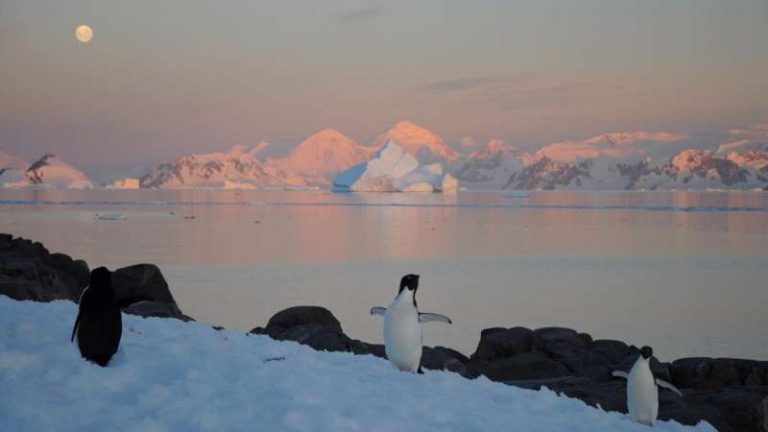
Researchers say that extreme events such as ocean heatwaves and ice melt will become more frequent and severe in Antarctica.
Scientists warn that drastic measures are needed to limit Global Warming at the Paris Agreement Target of 1.5degC. Recent extremes in Antarctica could be just the tip of the iceberg.
The study examines evidence of extreme events in Antarctica and the Southern Ocean. This includes weather, sea ice, ocean temperatures, and glacier and shelf systems.
The report concludes that Antarctica’s fragile environment “may be subjected to considerable stress and damages in future years and decade” and calls for urgent action to protect them.
Professor Martin Siegert of the University of Exeter, the lead author of this study, said: “Antarctic changes have global implications.” “Our best hope for preserving Antarctica is to reduce greenhouse gases to zero. This must be important to all countries and individuals on the planet.”
Professor Siegert stated that the rapid changes occurring in Antarctica could put many countries at risk of breaking an international treaty.
He said that the signatories of the Antarctic Treaty, including the UK, the U.S.A., India, and China, pledged to preserve the fragile and remote environment.
“Nations should understand that by continuing exploration, extraction and burning fossils in any part of the world, their environmental pledge will be violated.”
Researchers studied the vulnerability of Antarctica in the face of various extreme events to better understand their causes and future changes following a recent series of extremes.
The world’s largest heatwave (38.5degC over the average) occurred in East Antarctica between 2022 and 2023. Currently, the winter sea ice is at its lowest level ever.
Extreme events may also have an impact on biodiversity. High temperatures, for example, have been associated with years of lower krill counts, resulting in breeding failures among predators that depend on krill.
The University of Leeds’ co-author, Professor Anna Hogg, said: “Our results demonstrate that extreme events impact remote polar areas as well. They affect Europe through heat waves, wildfires, and heavy rainfall.
Extreme events hurt Antarctic glaciers, sea ice, and ecosystems. Therefore, it is essential to implement international treaties and policies for these beautiful but fragile regions to be protected.
Dr. Caroline Holmes is a sea-ice expert with the British Antarctic Survey. She said: “Antarctic Sea Ice has grabbed headlines over the past few weeks. This paper shows that sea-ice records have been falling in Antarctica for several years, first record highs, then record lows, starting in 2017.
The Antarctic physical and biological systems are vulnerable to human interference in almost every aspect.
Researchers say that the retreat of Antarctic sea ice will allow ships to access new areas. They also warn that careful management is required to protect sensitive sites.
Copernicus Sentinel satellites from the European Space Agency (ESA) and European Commission (EC) are essential for monitoring the entire Antarctic region and the Southern Ocean.
The data collected can be used for measuring ice speed, sea ice thickness, and ice losses with an exceptionally high resolution.