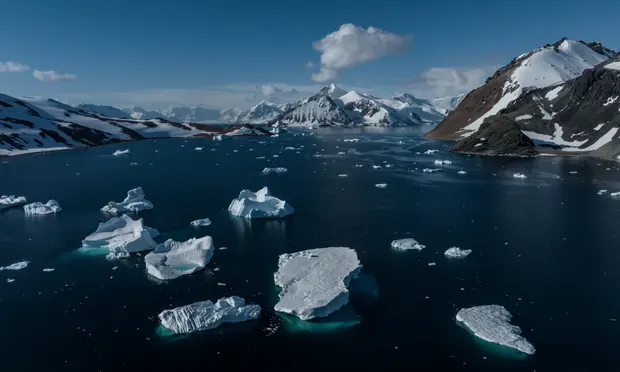
New research indicates that a significant global deep-ocean current has slowed by about 30% due to melting Antarctic ice since the 1990s. According to a recent study, this could severely affect Earth’s weather patterns and sea level.
It also determines how much heat and carbon dioxide the oceans store. It also determines the amount of heat and carbon dioxide stored in the oceans. Scientists warn that a slowdown could lead to drastic effects, such as increasing sea levels and changing weather patterns.
The study’s co-author, Dr. Steve Rintoul, is an oceanographer and Southern Ocean expert at Australia’s Commonwealth Scientific and Industrial Research Organisation.
It’s a problem because it affects many aspects of Earth, such as climate, sea level, and marine life.
This finding follows months of modeling in which Rintoul participated, which predicted a 40% decrease in circulation by 2050.
Rintoul stated, “The model projections for rapid changes in the deep ocean circulatory system in response to melting Antarctic ice may have been conservative.” “We are seeing ocean changes that were predicted to occur only a few years from now.”
Overturning circulation is caused by the dense and cold waters of Antarctica’s continental shelves that descend deep and then spread to all ocean basins. It returns nutrients and oxygen to the surface of the ocean.
Rintoul explained that the shelf water was not as dense because it was less salted than before.
Researchers found that melting Antarctic glacial ice has led to an increase in freshwater and buoyancy.
Researchers believe that a “circumpolar cooling” has occurred. The study focused on changes in overturning currents in the Australian Antarctic basin.
Rintoul stated that the Australian Antarctic basin was the best-ventilated deep basin regarding oxygen-rich water reaching the bottom. The signal from that basin could be a warning for changes around Antarctica.
Dr. Ariaan Purich, a Monash University researcher who was not part of the research, stated that the Australian Antarctic basin is downstream from the region of Antarctica, where the most excellent melting of ice shelves, and the loss of land ice, occurs. In that sense, the Australian Antarctic basin is an important area to study to see how meltwater impacts ocean circulation.
Purich said the paper was significant because it provided observational evidence of the slowing down of large-scale overturning of oceans due to melting Antarctic ice sheets.
Purich stated, “We’re seeing many lines showing that meltwater isn’t just increasing sea levels; it’s also affecting the climate in many different ways.”
This is a daunting situation. “These are major changes in Antarctica which can have a global impact on our climate.”
The study concluded that between 1994 and 2017, there was a net decrease in circulation of 0.8 sverdrups every decade. A sverdrup equals 1 million cubic meters per second.
Researchers found that increased sea ice production between 2009 and 2017 temporarily increased the overturning of circulation. Rintoul stated, “That was enough to cover the glacial melt for a couple of years.”
“We expect that in the long term, while there may be some ups and downs, Antarctica will lose more ice and melt more. This will slowly slow down the overturning circulation.
He said, “Unless we take action soon, we will be forced to make changes we would rather avoid.” “We must act now to reduce emissions and do all we can to achieve this as quickly as possible.”
The study was first published in the journal Nature Climate Change.