Researchers say that high phosphorus concentrations were detected in the ice crystals blown from Saturn’s moon Enceladus. This could indicate the presence of life on Enceladus.
Phosphorus is essential to the DNA structure and is a part of all cell membranes, energy-carrying molecules, and life forms on Earth.
This essential mineral was discovered based on NASA’s Cassini, the first spacecraft to orbit Saturn. Cassini spent 13 years exploring the giant gaseous planet Saturn, its rings, and moons between 2004 and 2017.
NASA’s Jet Propulsion Laboratory, located outside Los Angeles and led by German scientists, published the findings in Nature. The JPL designed and built Cassini.
The same team confirmed previously that Enceladus ice grains contained a rich array of minerals and organic compounds, including ingredients for amino acids. These are associated with the life we know today.
The latest study is based on Cassini’s measurements while flying through the salt-rich grains of ice ejected from geysers that erupted from the subsurface ocean underneath Enceladus’ frozen crust.
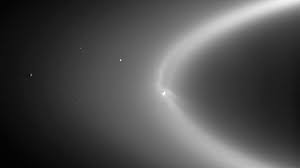
The spacecraft collected its data by passing through a plume containing ice crystals and the material that supplies Saturn’s “E” ring, a faint ring outside the planet’s main rings.
Enceladus, about one-seventh of the size and sixth largest natural satellite of Saturn (outside the Earth), has been identified as a candidate for the search to find places beyond Earth where microbes can live.
Europa, Jupiter’s more enormous moon, is another that is thought to contain a liquid ocean beneath its icy surface.
The study’s co-authors in Europe and Japan showed that the phosphorus concentrations of Enceladus are at least 100 times higher than the Earth’s oceans. They also found that the phosphate compounds in the water-soluble form of phosphorus were bound.
This is a fantastic discovery for astrobiology.”
Scientists stressed that while the presence of phosphorus and complex organic compounds and water, among other building blocks for life, is evidence that Enceladus could be habitable, it does not mean it is inhabited.
No evidence of life, past or present, exists elsewhere than Earth.
Whether life could have evolved in the Enceladus Ocean is still open.