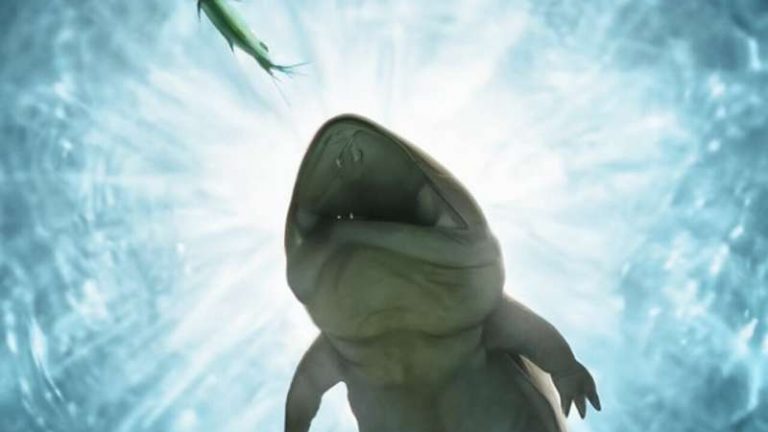
Scientists have identified a mystery fossil accidentally discovered by an Australian poultry farmer in the 90s as a large amphibian, complete with tusks.
Mihail Mihailidis discovered the 240-million-year-old dinosaur fossil while he washed a large sandstone slab intended to be a retaining wall for his garden.
Scientists have spent almost 30 years trying to determine the animal species the specimen belonged to.
University of New South Wales Paleontologist Lachlan Hart said that it was now identified as a “heavyset amphibian” measuring 1.2m (nearly 4 feet) from the snout until the tail, resembling a mix between a crocodile and a giant salamander.
He said it probably preyed on fish in freshwater using its “pretty sharp teeth” and its “tusks like fangs on the roof its mouth.”
Hart stated that it is rare to find skeletons still with their head and bodies attached. Soft tissue preservation was even rare.
Researchers have named the creature “Arenaerpeton Supinatus,” which roughly translates to “supine Sand Creeper.”
Hart explained that the animals, known as “temnospondyls,” roamed Earth before dinosaurs.
Researchers ran the fossil through a giant scanner, more commonly used for searching cargoes for contraband.
The fossil was discovered in the mid-1990s near the seaside village of Umina Beach in New South Wales. Umina Beach is about an hour north of Sydney.
Time Magazine suggested it could “amplify [the story of] human evolution.”
Matthew McCurry, a paleontologist at the Australian Museum, said: “This is a fossil that is among the most significant to have been found in New South Wales over the last 30 years. It is exciting to describe it in formal terms.”
It is a significant part of Australia’s fossil heritage.