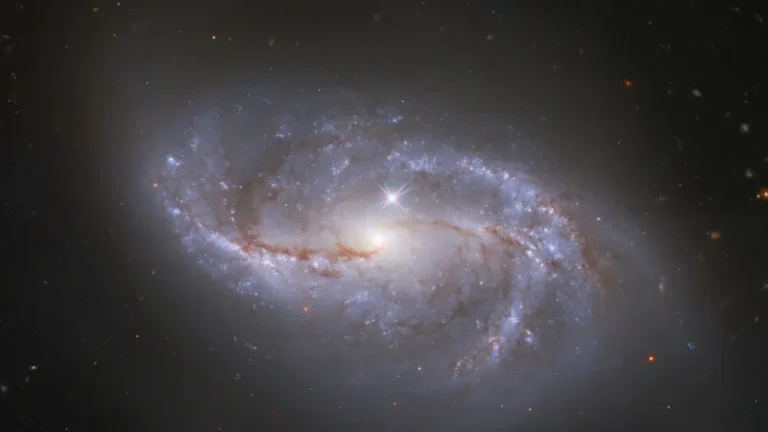
An observatory in Antarctica collected data that allowed us to see the Milky Way galaxy from the perspective of neutrino particles. This is the first time we’ve seen our Milky Way galaxy “painted” by a neutrino particle rather than different wavelengths of visible light.
Researchers have a new way to look at the universe thanks to a result published in Science. Scientists believe that neutrinos can be created by charged high-energy particles, called cosmic rays, colliding with matter. We still know much about cosmic rays, but our detection equipment is limited. Neutrinos are a way to study them.
Since antiquity, it has been believed that the Milky Way is made up of stars similar to our Sun. It was first recognized in the 18th century as a flattened slab made up of stars. Only 100 years ago, we discovered that the Milky Way was a Galaxy or “island Universe” amongst a hundred billion other galaxies.
Edwin Hubble, an American astronomer, identified 1923 a pulsating type of star known as a “Cepheid Variable” within the Andromeda Nebula (a giant cloud of gas and dust). Henrietta Swan Leavitt’s previous work estimated the distance between Earth and Andromeda.
This proved that Andromeda was a galaxy far away like ours, ending a long-running argument and ultimately changing the conception of our place within the universe.
Opening Windows
As a new astronomical window opened onto the sky, we saw our galactic home through many different wavelengths — radio waves, various infrared bands in X-rays, and gamma rays. We can now see our galactic home in neutrino particle, which has shallow mass and interacts very weakly with matter.
Neutrinos are released from our galaxy when cosmic rays and interstellar material collide. Neutrinos can also be produced by the Sun, by some supernovas or exploding stars, and by many high-energy phenomena in the universe, such as gamma-ray bursts. They can give us a unique view of the highly energetic processes that are taking place in our galaxy, a view we cannot get by using only light.
A “telescope” buried under the South Pole, several kilometers deep in the Antarctica ice cap, was needed to make the discovery. The IceCube Neutrino Observatory detects a form of energy called Cherenkov Radiation using a gigatonne ultra-transparent ice.
The charged particles that emit this faint radiation can travel faster in ice than light, but not in a vacuum. These particles are produced by neutrinos that hit the atoms of the ice.
The main component of cosmic rays is proton particles. These are the particles that make up atomic nuclei, along with neutrons. They also include electrons and heavy hearts. Around a century back, it was discovered that they were raining uniformly down from all directions on Earth. The magnetic fields in space between stars have distorted their travel directions, so we have yet to determine their exact origins.
Deep on the ice
Neutrinos are unique markers of interactions between cosmic rays deep within the Milky Way. The ghostly particles can also be generated when cosmic radiation hits the Earth’s atmospheric layer. Researchers using IceCube data had to find a way to distinguish between neutrinos with “astrophysical origin” – from extraterrestrials – and those produced by cosmic ray collisions in our atmosphere.
Researchers focused on cascades, a form of neutrino interactions in the ice. The researchers detected the Milky Way’s astrophysical Neutrinos better by concentrating on a flood of neutrinos. It is because the cascade gives a more accurate measurement of the energy of a Neutrino than other types, even though it’s harder to reconstruct.
The analysis of IceCube data over ten years using advanced machine learning techniques revealed nearly 60,000 neutrino events with energies above 500 gigaelectronvolts. Only 7% of these neutrinos were astrophysical, and the rest came from the Earth’s atmospheric “background source” of neutrinos.
At a statistical significance level known as 4.5sigma, the hypothesis that all neutrino events were caused by cosmic rays striking the Earth’s atmospheric layer was conclusively rejected. Our result is unlikely to be a fluke, with a probability of only 1 in 150,000.
This is below the five sigmas conventional standard for claiming to have made a particle physics discovery. This emission is expected for astrophysical reasons.
The upcoming expansion of the experiment, IceCube Gen2, will be ten times larger. We will collect many more neutrino events, and the blurry image will become a detailed picture of our galaxy.