Elizabeth Kodela, 80, was astonished to discover that her love of ancient rocks led her to visit the Eromanga outback of Queensland. She had no idea that the town would install a 3D-printed dinosaur nest.
She traveled to Eromanga from Brisbane in 2019 to volunteer and pursue her long-held interest in fossils.
“I have always been fascinated by rocks. I don’t even know why. I’ve loved them since I was a little girl,” said Ms Kodela.
My window sills have been covered with rocks and fossils dating back many years.
The octogenarian, Ph.D. students, scientists, and volunteers visit the town in short stints to assist in the “painstaking process” of uncovering 90-million-year-old dinosaur bones.
She said, “We get sore fingers and dust-filled noses… but it’s one of the most rewarding experiences we’ve ever had.”
She wanted to give something back to the community that had welcomed her more than 1,000km from her Brisbane home.
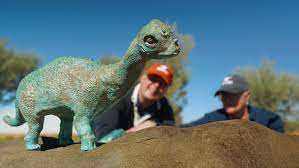
She commissioned a 3D sculpture of a Titanosaur Sauropod Nest, a modern take on fossils from prehistoric times.
She said, “I thought we needed something to attract more tourists. Something that would last forever if it were possible.”
Ancient landscapes transformed into modern art.
The 2.5-meter piece, which features a nest of baby dinosaurs with their eggs, was created using giant 3D printing machines in New South Wales.
The bronze was cast, and the concrete was reinforced with glass to stand up against the harsh conditions of Queensland’s outback.
Steven Rosewell, the designer behind it, gathered information from paleontologists worldwide. However, he also used a little artistic license.
He said, “We had one embryo [of sauropod] from which we could form the basic shape of a skull, but that was it.”
The rest was winging it.
The sculpture was installed to coincide with the second anniversary of discovering Australia’s giant dinosaur, Cooper, located west of Eromanga.
A Titanosaur adult would have been 30 meters long and weighed more than 60 tonnes.
Since Mr. Rosewell bought his first 3D printer 23 years ago, technology has revolutionized the sculpture and film props manufacturing business.
He said that sitting with clay was very time-consuming. “It is much easier to do it on the computer.”
Dino tourism is booming.
The Queensland Tourism Association has said that COVID tourism is partly responsible for the dramatic increase in visits to the Eromanga Museum.
However, the cost of living crisis has led to a slower start for the paleo tourism industry this year.
The museum’s Operations Manager, Corey Richards, hoped the sculpture would encourage more tourists.
He said, “We hope people can connect with these giants and understand how they began their journey as infants like us.”
Ms. Kodela stated that she had yet to see the sculpture’s final form in its new location but planned to visit it in the coming weeks.
She said, “I am very grateful to have met Eromanga staff, who are like a big family.”