Ancient grains of dust reveal the life story of a Solar System Asteroid.
A study of grains from Ryugu suggests that at least a part of this carbon-rich rock began its life far from the Sun before it ended up in the belt of the asteroid and, finally, at roughly Earth distance from the Sun.
Asteroids have a complex history that involves multiple migrations throughout the Solar System. They also contain valuable records from different periods in the Solar System’s history.
It’s a C-type asteroid, the most common type, rich in carbon and a href=”https://www.sciencealert.com/water-vapor-detected”>water/a>, and scattered throughout the href=”https://www.sciencealert.com/jwst has accidentally detected â€a tiny asteroid hidden between Jupiter and marsâ€. It is a C-type asteroid, which is the most common. They’re rich in water and can be found in the Main Belt.
Ryugu’s orbit around the Sun is close to Earth’s, suggesting some disruption that sent it out of the Main Belt long ago. Its orbit is close to Earth, which indicates that it was pushed out of the belt by some disruption.
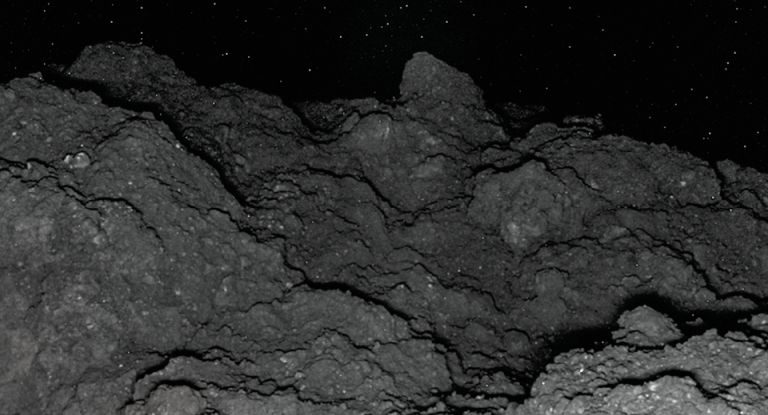
Hayabusa2, launched in 2014 by the Japan Aerospace Exploration Agency (JAXA), surveyed Ryugu between 2018 and 2019 before returning to Earth in 2020. Hayabusa2 collected samples and found that the 900-meter (2950-foot) asteroid is not a single large rock but a ” Rubble Pile,” a loosely-bound collection of smaller stones.
Ryugu shares many similarities with asteroids in the asteroid belt, especially those belonging to the Polana or Eulalia families. A growing number of analyses of samples from Ryugu have shown that some minerals in the rubble are consistent with material from the outer Solar System.
It has, for example, a lot of organic matter. This is similar to comets which are generally from the outer Solar System. Isotopes are also consistent with the outer Solar System.
An international team led by Rosario Brunetto of the University of Paris-Sarclay, France, has examined grains rich in olivine, pyroxene, and amorphous silicon. Such silicon is the least affected by water.
Brunetto’s team studied these grains using infrared spectrometry and discovered that they reflect infrared light similar to objects in the outer Solar System with more distant origins. They include the asteroid Hektor and a Trojan from the swarms that share Jupiter’s orbit. Comet Hale Bopp is also included.
Researchers say that these results indicate that the primary mother body of Ryugu, which was formed by outer Solar System components, was a “planetesimal” – the seed that could grow into planets – initially starting in the outer Solar System. Its growth was disrupted, possibly by breaking it up, and it was sent to the Main Belt, where water altered and transformed it.
Researchers say that Ryugu is a significant record of the development of the Solar System.
Their paper states that “Ryugu returned samples are one key to accessing the source of asteroids spectral variety because their more pristine and crystalline lithologies have anhydrous grains similar in spectral properties to some primitive outer solar system bodies.”
This suggests that Ryugu may contain several reservoirs of anhydrous primitive particles, which can provide valuable information about the formation and evolution of planetesimals within the protoplanetary disc.