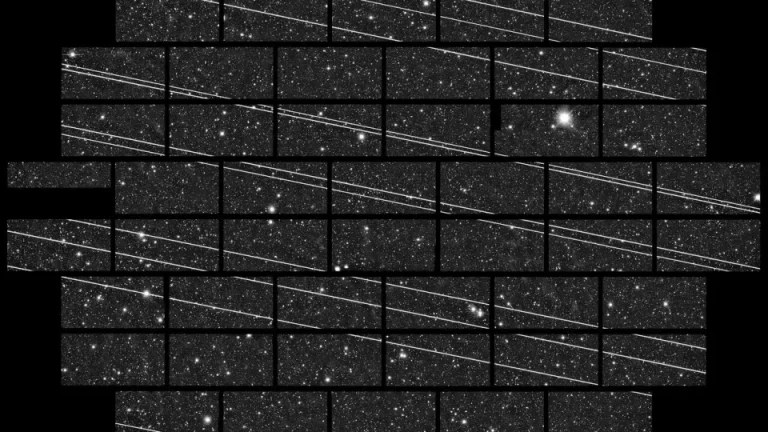
Starlink satellites make thousands of avoidance maneuvers as low Earth orbit gets more crowded. This is fueling fears that an impact will be inevitable.
In a recent filing, SpaceX told the Federal Communications Commission that its orbital communication satellites had performed just over 25,000 maneuvers in the six months between December 1, 2020, and May 21, 2030. The company said its maneuvering threshold is “an entire order of magnitude” higher than the industry standard. SpaceX moves its satellites when the likelihood of a collision exceeds 1 in 100,000. NASA and other companies use a 1 in 10,000 threshold.
The number of collision avoidance moves is correlated with the growth of the Starlink constellation: For this most recent period, SpaceX reported adding 457 satellites to orbit. The number of avoidance maneuvers is associated with the development of Starlink: SpaceX has said that it added 457 satellites in orbit during the most recent reporting period.
Over 1,300 of the 25,000 maneuvers were performed to avoid debris from Russia’s anti-satellite demonstration test in November 2021. The filing stated that while only 9% of waste from the trial was still in orbit, this debris posed the most significant overall risk for Starlink satellites.
SpaceX is one of many companies planning to create a massive constellation in orbit. Even if these projects fail, tens of thousands of objects will likely remain in orbit by the end of the decade.
A study published just a few weeks after SpaceX submitted its report found that Starlink satellites emit “unintended electro-magnetic radiation,” which could impact astronomical research. The study’s authors used a Low-Frequency Array telescope that is very sensitive to detect radiation from 68 Starlink Satellites. The signals are different from those astronomers had to deal with in the past from communication satellites.
The study’s authors conducted simulations to show the compounding effects of radiation from satellite constellations.
Benjamin Winkel, co-author of the study at the Max Planck Institute for Radio Astronomy in Germany, said: “Our simulations showed that the bigger the constellation is, the greater this effect will be as the radiation from the satellites accumulates.” This makes us worry not only about existing constellations but also about those planned — and about the lack of clear regulations protecting the radio astronomy band from unintended exposure.
Federico Di Vruno is the study’s lead author and co-director of the International Astronomical Union Centre for the Protection of the Dark and Quiet Sky. IAU is one of the loudest organizations regarding the possible impacts of satellite constellations. A press release about the study stated that the authors were “in close communication” with SpaceX and that the company had already made changes to its next generation of Starlink Satellites to mitigate the impact of the emissions.