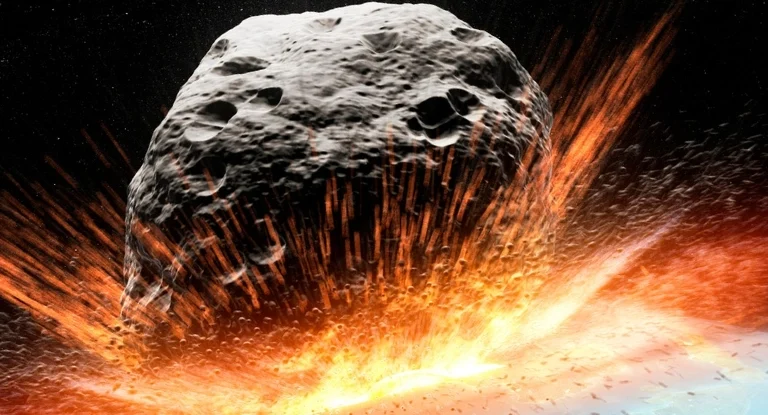
As inevitable as the rising Sun and the changing tides. One day, another large rock will fall from the sky and crash into Earth. It has been happening for billions and will continue for many more.
As of yet, humanity has not faced such a devastating threat. If we want to live on this planet in the long run, we must accept that asteroids are dangerous and be prepared.
Around the globe, organizations continue to monitor the sky. They create maps and catalogs for all potentially dangerous near-Earth Objects or NEOS. The larger rocks are more complicated, but they’re also less common. While our list of hazardous NEOs has yet to be completed, we have accurate maps of all the asteroids that are potentially hazardous and more significant than one kilometer.
It is important to note that kilometer-sized asteroids could destroy entire cities and cause severe ecological damage across the globe.
A team of astronomers has calculated the orbits of these large NEOs for the next 1000 years. They conclude that none of the kilometer-sized NEOs will severely threaten humanity over the next 100 years.
We have a lot to predict their orbits beyond that. It is because, in orbital dynamics, even small changes can significantly impact enormous timescales. An asteroid’s trajectory could be altered by a slight difference in the amount that it receives heat from the Sun.
Astronomers examined the distance between known dangerous NEOs and Earth. The astronomers studied how the closest distance between NEOs and Earth changes over hundreds of thousands of years. This was done through a series of simulations that mapped as many orbital paths as possible, given NEOs’ uncertainties in orbital positions and velocity.
Astronomers have identified Asteroid 7482 as a particularly hazardous NEO. This asteroid is expected to spend significant time near the Earth over the next millennium. This doesn’t mean it will hit our planet, but it is the most likely to do so within the next 1,000 years.
Researchers also pointed out Asteroid 143651, which has a chaotic orbit, making it impossible to predict the exact location of this asteroid beyond a few years. It is impossible to say whether it poses a threat based on the current knowledge of its location and velocity.
The astronomers have identified 28 candidates with a probability greater than zero of a “deep contact,” meaning they will pass less than the distance from the Moon.
These objects will unlikely hit Earth within the next 100 or 1000 years. But if we want to live long-term, we must be aware of them.