According to the most popular cosmological models we use, Dark Matter is responsible for approximately 85% of all mass in the Universe. While there is no direct evidence of this invisible, mysterious mass, astrophysicists can measure its influence through Dark Matter Haloes and gravitational lenses. They also use the effects of General Relativity to determine the large-scale cosmic structure. Dark Matter will soon be no mystery with the help of next-generation space telescopes like NASA’s Nancy Grace Roman and ESA’s Euclid.
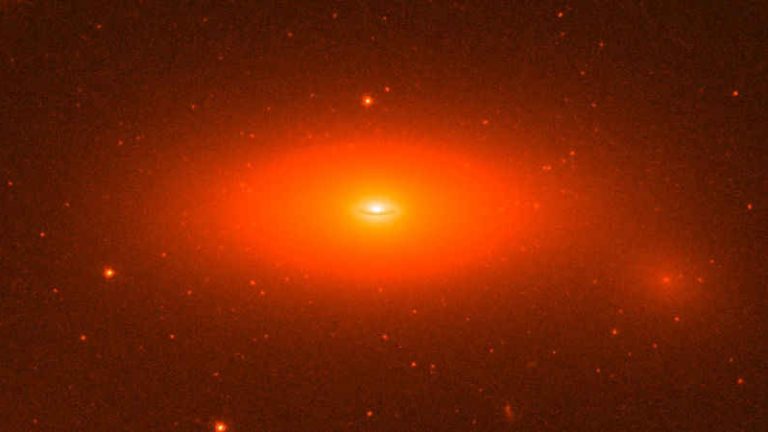
Then comes this: a massive galaxy that has very little Dark Matter. When observing NGC 1277, a group of astronomers led by the Instituto Astrofisica de Canarias members observed this exact thing. This lenticular galaxy, located 240 million light-years from Earth in Perseus’s constellation, is many times more massive than our Milky Way. This is the very first enormous galaxy that has not shown any signs of Dark Matter. It is a significant challenge for current cosmological theories.
Sebastiencomeron conducted the research. He is an extragalactic astronomer from the Universidad de La Laguna, the IAC, and the Archaeology of Thick Discs leader. Researchers from the Instituto Nacional de Astrofisica Optica y Electronica, Consejo Nacional de Ciencia y Tecnologia National Academy of Sciences of Ukraine Instituto de Fisica de particular y del Cosmos, Max Planck Institute for Astronomy, and other universities joined him. Their findings were published in the journal Astronomy & Astrophysics.
According to the Standard Model of Cosmology, aka. Dark Matter was a crucial component in the creation and evolution of our Universe. This invisible mass was present shortly after the Big Bang, forming halos that attracted neutral hydrogen into spiraling disks. Gas was gathered into dense clouds that triggered the formation of galaxies and stars. DM is a critical component in all massive galaxies. It is visible by the rotational curves of the galaxies, their lenses, and interactions with the surrounding stars and intergalactic media (IGM).
When the team measured NGC 1277’s mass distribution, they only observed the distribution of its star. They concluded that DM couldn’t account for more than 5% within the observed radius of the galaxy, even though their observations suggested that DM might not exist at all. Cameron explained this in a recent IAC Press Release.
This result does not match the current accepted cosmological model, which includes dark Matter. We used an integral field spectrograph to observe NGC1277 because relic galaxies are essential in understanding how galaxies first formed. We made kinematic charts from the spectra. This allowed us to determine the mass distribution in the Universe up to a distance of 20,000 light-years.