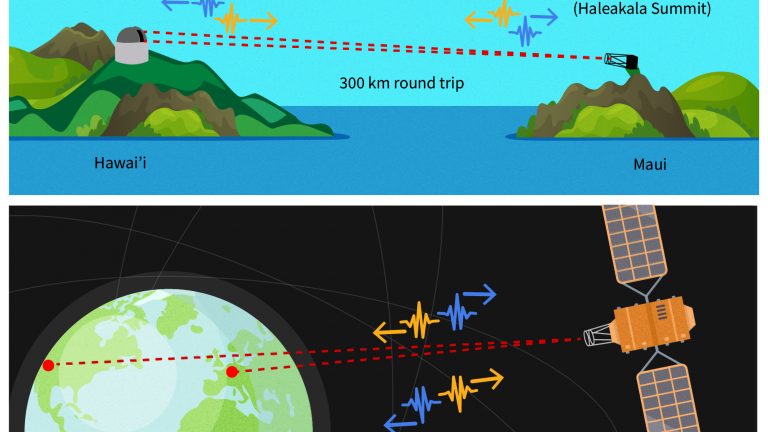
Scientists in Hawaii drove up the Mauna Loa Volcano, pointed a laser beam at a reflector on Haleakala Peak on Maui, and sent rapid pulses through turbulent air for 150 kilometers. While highly faint, the vibrations demonstrated a capability that physicists have long sought: the ability to transmit time signals between distant locations with powers compatible with future space missions.
Scientists from the National Institute of Standards and Technology, including the team that obtained the results, could transfer time from the Earth to satellites in geosynchronous orbit 36,000 km away, stationary over a point of the Earth’s surface. This method could allow time synchronization with femtosecond accuracy – 10,000 more than current satellite approaches. The system could synchronize using the minimum possible timing signal strength. This would make it highly resilient in the face of atmospheric disturbances.
This vastly higher level of coordination between remote devices opens up several intriguing possibilities. The current microwave-based signaling methods cannot transmit the precision needed across continents. This new method could enable optical clocks on opposite sides of the planet to be connected through a geosynchronous orbiting satellite without incurring any penalty. It would also support the future redefinition of the SI second as a standard. The linking of optical atomic clocks globally can also be used to make fundamental measurements, from testing general relativity to exploring the dark matter.
It is optional to have optical atomic clocks for all applications. The ability of an array of widely separated sensors could be used in VLBI (very long baseline interferometry) for improved imaging of black holes, among other things.
Laura Sinclair is a physicist on NIST’s Boulder Campus and the author of the team’s research paper, which was published today in the journal Nature. We envision using these sensor arrays to view the Earth and space from above. These arrays’ implementation depends on the connection of highly accurate optical clocks. Our results show that we have now developed a tool to do that.
The experiment demonstrated that the high-frequency signal from an optical clock could be sent and received using the most recent invention of the team, the time-programmable frequency combing, an innovative use of frequency comb technology. Sinclair stated that the novel frequency comb made these results possible.
Sinclair stated, “The expanded functionality of the Time-Programmable Frequency Comb allowed us to make these measurements.” We couldn’t get these results without the time-programmable frequency comb.
A light beam must pass through our often turbulent and cloudy atmosphere to reach geosynchronous orbit. The team wanted to demonstrate that the signal could go to a satellite without getting lost during transit. They set up their novel frequency comb on two mountains, each 150 km away, high on the flanks of Mauna Loa in Hawai’i and on the summit of Haleakala in Hawai’i. The team sent the time-programmable frequency comb to Haleakala and received the reflection. This demonstrated that the signal could penetrate more atmospheric problems than when traveling to geosynchronous space.
The round trip was successful even with the minimum signal strength needed to synchronize the devices, which physicists call the “quantum limits.” The researchers demonstrated in their earlier work that the time-programmable frequency comb could operate at this quantum level, where less than one photon out of a billion can reach its target device. The laser could still work even when it was only sending out 40 microwatts, which is about 30 times lower than the power of a laser.